PART 1 – ONBOARD SHIP
Shipboard Organization : Seafarers’ Ranks, Duties and Salaries
Seafaring is a profession that requires ranks and duties to be specific, so that everyone onboard will know what to do, as several procedures have to be conducted at the same time; Thus, each one of these roles carries unique responsibilities which are crucial for the successful operation of a vessel.
Specifically, the ranks on a vessel are divided into three categories:
- The deck department
- The engineering department
- The steward’s / Catering department

In 1978, IMO adopted a landmark Convention for all seafarers across the world to establish high standards of competence and professionalism in their duties on-board. The International Convention on Standards of Training, Certification and Watchkeeping for Seafarers, the STCW Convention in brief, establishes the minimum basic requirements on training, certification and watchkeeping for seafarers on an international level.

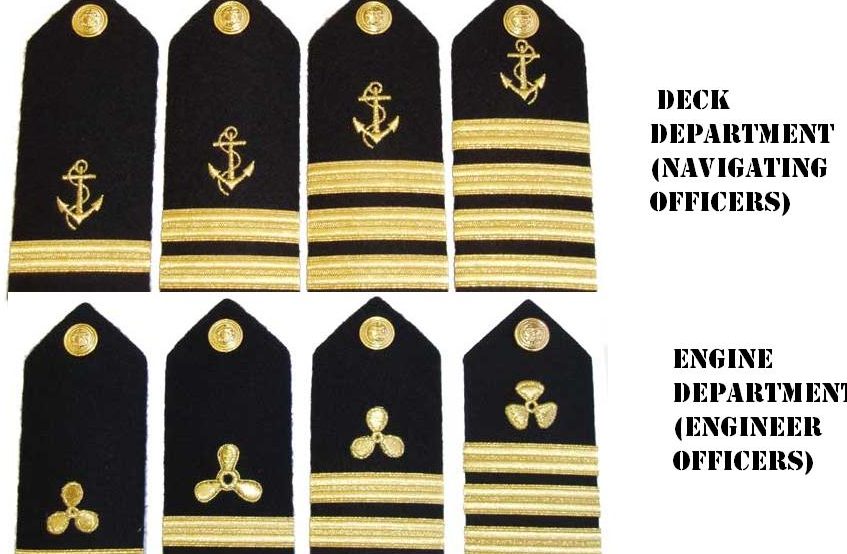
Deck department
Captain: The captain or master is the ship’s highest responsible officer, acting on behalf of the shipowner. He/she is responsible for all operations onboard.
Chief mate: The head of the deck department on a merchant vessel, second-in-command after the ship’s Master. This position is responsible for cargo operations, the vessel’s stability, the deck crew and the safety and security of the vessel. The chief mate is the one to train the crew and cadets on various operations, such as safety, firefighting, search and rescue, and various other contingencies.
Second mate: The one that holds this position is a qualified Officer in Charge for Navigational Watch (OICNW), responsible for directing the bridge and navigating the ship. The second mate is the third most experienced deck department officer after the Captain/Master and Chief mate. One of their priorities is to update charts and publications, keeping them current, making passage plans, and all aspects of ship navigation. Additional duties include directing line handlers, cargo watches, directing anchor detail and training and instructing crew members.
Third mate: The third officer is responsible for the maintenance of life-saving equipment and fire-fighting equipment under Safety Officer`s instruction. Also, the third mate conducts the drilling operations and handles all the port documents on behalf of the Master.
Deck cadet: Also known as the Trainee Navigational Officer or Nautical Apprentice is an apprentice who must learn the basic duties, comprehend and apply the new skills learned.
Deck cadet ratings
- Bosun (head of the rating staff)
- Welder/Fitter (this rank onboard renders his services to both the deck as well as the engine department)
- Able Bodied Seaman (AB)
- Ordinary Seaman (OS)
- Trainee OS
Engineer/Technical Department
Chief engineer: This person is the one overseeing the engine department and gives work orders for the ones operating in the engine room.
Second engineer: This rank is responsible for supervising the daily maintenance and operation of the engine department, directly reporting to the chief engineer.
Third engineer: The third engineer or second assistant engineer is the one dealing with boilers, fuel, auxiliary engines, condensate and feed systems, always reporting to the second engineer.
Fourth engineer: The fourth engineer or third assistant engineer is junior to the second assistant engineer/third engineer in the engine department.
Steward’s / Catering department
Chief cook: The chief cook is the senior unlicensed crew member working in the steward’s department of a ship. Their duty is to prepare meals regularly for the crew and passengers, inspects the galley and equipment ensuring all cleaning and proper storage operations are in line.
Chief steward: This position is the one handling the catering department, by directing, instructing and assigning personnel for preparing and serving meals. Also, this rank plans the menu, orders the supplies along with the Master.
BROAD SCENARIO OF SHIP ORGANIZATION
A shipboard organization is similar to the government structure we have in our countries.
Vessels have worlds of their own. They are like mini kingdoms having a very small population with each person holding specific duties. The duties vary depending on the crew’s rank.
20 strong men runs a normal seagoing merchant vessel on average. They are divided into three departments namely Deck, Engine, and Catering. These departments have various tasks during drills, emergencies, and security duties.
Knowing the importance of a shipboard organizational plan gives you an overview of the way a vessel functions.
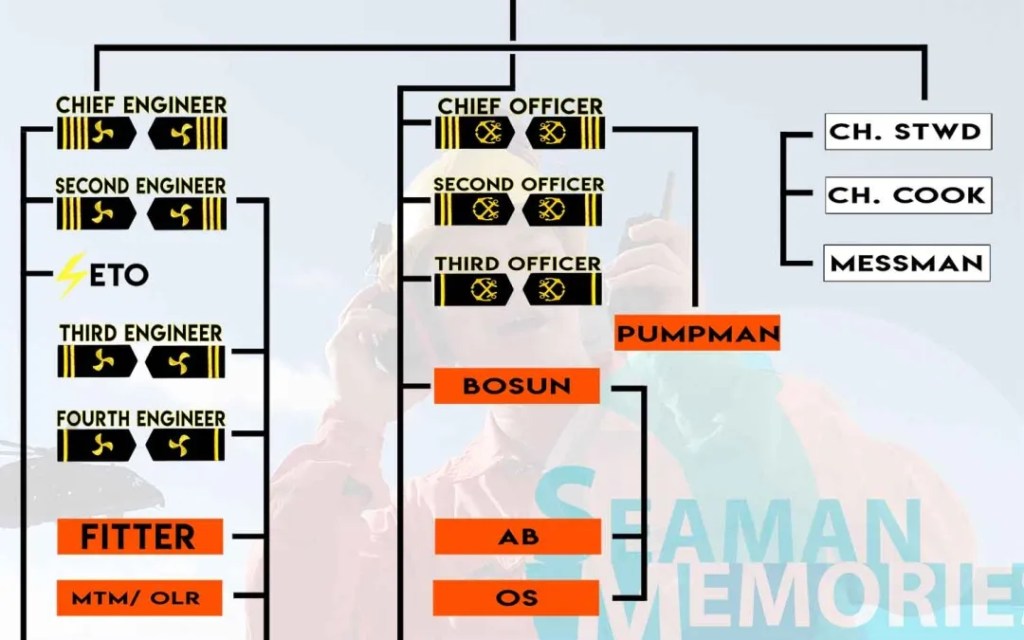
Shipboard Organizational Chart
To better understand how the chain of command flows on board, one must look at the vessel’s organizational chart. This chart shows various departments running the ship including their department heads.
Each of the crew functions based on the ranks outlined in their job description. The shipboard organization makes it easy for everyone to identify the degree of responsibility of every person on board.
Variations
On every ship, the overall command goes to the Master/Captain. Under him are the three departments: Deck, Engineering, and Steward or Catering. The chart above best describes this hierarchy.
However, there are companies in which the Catering department is under the umbrella of the Chief Officer.
Not only that, there are shipboard organizational structures that consider the Cadet as part of the officers. Others however put him in the lowest rank just below the Ordinary Seaman or Wipers.
There are no wrong answers here as each company have different policy. As long as the crew runs the ship safely and complies with various rules and regulations, this should not be a problem.
Deck Department
The Deck department is the unit responsible for navigation, watchkeeping, maintenance of the ship’s hull, cargo hold preparation, and loading and unloading of cargoes.
Additionally, they are also responsible for keeping the lifesaving and fire fighting equipment in good order.
Mooring, un-mooring, anchoring, and ballasting operations fall under the care of the deck department.
The Master
On top of every shipboard organization is the Master. He is the overall commander having absolute authority on board.
This absolute authority means he has the overriding decision against the desires of the company and charterers. Of course, his judgment is always based on the safety of the vessel her crew, and cargo.
Interchangeably, he is also called the Captain of the ship. Even when there are superintendents, shipowners, and inspectors on board, he still has absolute command.
These visitors can not interfere with the ship’s operation without permission from the Captain.
When there are accidents, incidents, or deficiencies, the Master will be deemed responsible for it unless he can prove it otherwise.
Generally, the deck crew conducts surface maintenance of the deck including its fittings and equipment.
This is one reason why he’s paid USD10,000.00 on average!
Chief Officer
The Chief Officer is the Master’s second in command. He is the person to take over the control of the ship whenever the Master is incapacitated.
Sometimes called the Chief Mate, First Officer, or First Mate, he is primarily responsible for everything related to cargo operations.
He is the training manager, garbage manager, rest hours supervisor, disciplinarian, and job administrator.
Some ships have three Junior Officers making the Chief Mate a day worker- 8 am to 12 noon, 1 pm to 5 pm. However, there are still ships with only 2 Junior Officers.
This makes the Chief Mate a 4 to 8 watch keeper (AM/ PM) despite the huge jobs he has. His salary ranges from $6,000 to $12,000.
Second Officer
Typically stands at 12 to 4 watch (AM and PM), the second officer is also called the navigational officer. From what we see on the organizational chart, he is the rank below the Chief Mate and just above the Third Officer.
Since he is the navigational officer, his main duty revolves around the bridge. He is in charge of fixing the voyage plans, chart corrections, and publication updates.
More importantly, he makes sure that all navigational instruments and light signals are working and tested regularly.
The duty of a second mate includes cargo operations, ballasting operation, and mooring/ unmooring of the ship. On some ships, he is also designated as the Ship Security Officer (SSO).
His salary is approximately $2,500 to $5,000.
Third Officer
A Third Mate’s watch is from 8 to 12 (AM-PM). He is usually the safety officer on board. This means that his duty involves the care and maintenance of all lifesaving and firefighting equipment.
Whenever there are on-signers, the third Mate is in charge of their familiarization. He gives them a tour of all the safety and fire fighting equipment once on board.
In cooperation with the Chief Mate, his duty also includes updating the Muster list and assigning the crew’s duties and responsibilities during emergencies.
Like the second officer, his job also involves cargo operations, ballasting operation, and mooring/ unmooring of the ship.
A Third Mate’s salary is around USD2,000 to USD4,500.
Bosun (Boatswain)
The Bosun is the head of the unlicensed deck department. With direct supervision from the Chief Officer, his main duty is keeping good maintenance of the ship’s hull.
The Bosun’s job revolves around the deck area. After getting the job order of the day from Chief Mate, he usually delegates the tasks to the deck crew.
The Bosun works closely with the Chief Officer. We mentioned that Chief Officer is also the garbage manager and disciplinarian. Well, that job is designated to the Boatswain too.
Though the Chief Mate is the head of deck maintenance, the hands and feet are the deck crew. The Bosun heads the nitty-gritty stuff on deck together with the ratings.
On average, a Bosun earns USD2,000 per month.
Pumpman
You can find the rank of a Pumpman in tanker ships. Sometimes, his salary is equivalent to that of a Bosun. In other companies, his wage is a bit higher by USD100.00 to USD300.00.
A Pumpman assists the Chief Officer during loading, discharging, and crude oil washing. Additionally, his duty also involves assisting in ballasting, de-ballasting, inerting, purging, gas-freeing, and tank washing.
His responsibilities revolve around the deck area with the cooperation of Bosun and other deck crew.
However, he’s mainly focused on the maintenance of cargo equipment, PV valves, IG valves, deck seal, tank gauging equipment, and connecting/ disconnecting of cargo hoses.
Able-bodies Seaman (AB)
The ABs are usually the ones steering the vessel during pilotage. They are either watch keepers or day workers. As watchkeepers, they are partnered with the deck officers respectively.
They are the ones doing all the maintenance jobs on deck like chipping, buffing, painting, washing, and greasing. Together with the Bosun, they do the nitty-gritty jobs like climbing and entry into enclosed spaces.
During cargo operations, they are the eyes and ears of the officers in the deck area. Their duties include checking the cargo lines for leaks, tendering the mooring lines, and watching the gangway.
An Able-bodied Seaman’s salary is about USD1,550.00.
Ordinary Seaman (OS)
An Ordinary Seaman is an entry-level rank in the deck department. His duty is very much like the ABs. However, he requires much supervision, especially the new ones. Hence, he normally works with an experienced AB.
An ordinary seaman is not allowed to steer the ship even if they have the necessary certificates. He is also not permitted to perform working aloft and tank entries.
However, he is permitted to do those things with direct supervision of a responsible crew or an officer.
His main duty is assisting the ABs while learning about the job so they can be ready to get a promotion.
An OS’s salary is about USD1,200.00.
Deck Cadet
On some shipboard organizations, the Deck Cadet is positioned just before the Third Officer. However, some organizational charts place him at the bottom of every department either deck or engine.
A Deck Cadet’s duties depend on the culture of the ship. On some vessels, he spends his time mostly on deck doing maintenance together with the ratings.
Meanwhile, some ships assign deck cadets only on the bridge. Still, a few follow the program laid out in their Training Record Book.
The main duty of a Cadet is training. He must learn the different jobs on board. He can achieve this through immersion.
Therefore, his training supervisor assigns him together with the officers. Additionally, he also sends him to the Pumpman and Bosun to get an overview of the various jobs on deck.
A Cadet’s salary is about USD600.00.
Engine Department (MARINE ENGINEER OFFICERS)
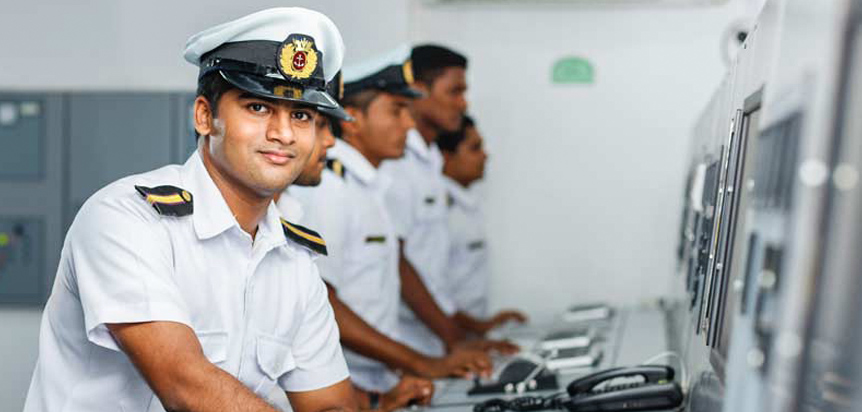
The engineering department is the term used referring to the crew working below deck or inside the engine room.
A ship is equipped with various machines, electrical equipment, and a propulsion system. It is the engine crew’s job to keep them running and in good working order.
Their work includes inspection, maintenance, and repair of all machinery. These include the main engine which is the heart of the ship.
Additionally, they are also in charge of power generators, air-conditioning plants, sewage systems, water distillation units, lighting, and electrical fixtures, and cooling units.
We can categorize the Engine Department into two: the licensed members called the marine engineers and the unlicensed crew called engine ratings.
Chief Engineer Officer (C/E)
The head of the shipboard engineering department is the Chief Engineer (C/E). He is overall in charge of engine room safety, machinery operation, maintenance, bunkering, and technical administration.
Specifically, he keeps very much attention to the paper works, checklists, and managerial tasks within his departments. He answers directly to the Captain.
Additionally, he is responsible that the Engineers make proper entries into the Oil Record Book and Engine Log Book.
The Chief Engineer also monitors the fuel and lube oil consumption. This means that the machinery in operation must achieve good and safe performance with economical consumption.
His salary is about USD7,500 to USD 15,000 depending on the ship type.
Second Engineer Officer(2/E)
Sometimes called First Assistant Engineer (1AE), the Second Engineer is the rank below Chief Engineer. He is the Executive Officer of the ship’s Engine Department.
Since the Chief Engineer is buried with paper works, the Second Engineer does the planning, scheduling, delegating, and directing of the maintenance plan inside the engine room.
Of course, those jobs must be in consultation with the Chief Engineer.
As the second in command, he earns USD8,000.00 on average every month.
Third Engineer Officer(3/E)
The 3rd Engineer is responsible to the Second Engineer for normal maintenance and watchkeeping duties. In other ships, he is also called Second Assistant Engineer (2AE).
He is responsible for the general maintenance of the machinery and equipment. Under the supervision of the 2nd Engineer, he ensures that there are sufficient bunkers in the day tanks.
Additionally, his work includes the upkeep of the main proportion, engines, boilers, and diesel generators as per the Planned Maintenance System (PMS).
A Third Engineer’s salary is between USD2,500 to USD5,000 a month depending on the company.
Fourth Engineer Officer(4/E)
A 4th Engineer’s job includes studying and practicing the 3rd Engr.’s duties. His day starts with a toolbox meeting with the other engineers and crew. The Second Engineer normally gives him the job for the day.
As the lowest engineer ranking on board, some of his duties include the maintenance of purifiers, air compressors, sewage treatment, and general maintenance.
His responsibilities may overlap or interchange with the other engineers due to different company regulations.
In some ships without an electrician, he is also in charge of electrical fixtures, water systems, and the sounding of bilges and tanks.
Sometimes referred to as 3rd Assistant Engineer (3AE), his salary is similar to that of the Third Officer. It is about USD2,000 to USD4,500.
Electrician or Electro-Technical Officer (ETO)
The Electrician is one of the most vital technical ranks on board. Since automation mostly runs a ship, an ETO plays a major role in keeping them running at all times.
In the vessel’s organizational hierarchy, the electrician reports directly to the Chief Engineer. He normally does not have a watch but is a day worker and can be called any time.
He also works in the deck department, especially with the Chief Officer.
An ETO’s job includes UMS tests schedules, alarms tests (fire, smoke, heat), battery checks, and refrigeration and air-conditioning units.
But that’s not all. Nearly all sorts of electronics and electrical problems even those found inside the bridge is a job for an electrician.
Sometimes called the Electrical Engineer, his pay starts at USD2,000 to USD8,000 depending on the ship type and company.
Fitter
A Fitter’s job on board is well, fitting a ship. But that’s too broad and too narrow at the same time. Fitters are highly skilled workers and are usually found inside the engine workshop. They are strong and adept in using various measuring tools.
Their expertise includes riveting, grinding, welding, drilling, and the use of lathe machines. They are very good at assembling, disassembling, reassembling, and building new parts of a machine.
Fitters are under the direct supervision of the Second Engineer which means that’s where he gets his jobs. Some of their works include repairs of piping systems, plumbing, fitting, and hot works. They also help out the engineers maintain their machinery.
On average, Fitters earn USD2,000 a month which is similar to the Bosun.
Motorman/ Oiler
A Motorman or Oiler’s job includes inspection and maintenance of pumps, motors, turbines, and condensers on board. His care for these equipment involves greasing, lubricating, de-rusting, and painting if necessary.
He keeps a record of his tasks and is directly responsible for the Second Engineer. Like the rest of the deck ratings, he also helps make the engine room clean and in good order. On some ships, his responsibility includes sounding bilges and bunker tanks.
Both the Oiler and Motorman take part during bunkering operations.
With a salary between USD1,300 to USD2,000, you can’t help but notice that they have the same pay and job description as the Oiler.
Wiper
The Wiper is the Ordinary Seaman’s counterpart in the engine room. His job mainly supports those ranks above him.
On most occasions, he is in charge of the general cleanliness of the engine room, engine workshop, and engine control room.
He can be seen assisting the engineers in cleaning the purifiers, dismantling motors, and doing routine maintenance.
Wipers must study and learn the jobs of Oilers, Motormen, and Fitters. With enough knowledge and experience, he can be promoted to those levels.
Engine Cadet
Like the Deck Cadet, an Engine Cadet’s duty is mainly to learn the different jobs in the Engine department. The Second Engineer normally supervise his training scheme.
Because of the various jobs in the engine room, he is normally paired with the Engineers, electricians, and even the ratings.
A cadet must absorb the learning he encounters in his work. He is a trainee to become an engineer even though his rank is below the engine department’s organizational diagram.
A Cadet’s salary is about USD600.00.
Steward Department
In most merchant vessels, the Steward department comprises the smallest number of crew in the shipboard organization.
But that doesn’t mean they’re less important. In fact, the Steward Department is the “backbone” of the organizational structure. Let’s take a look at what they do.
Sometimes, they are also called the Galley Catering Department. Their main job is to prepare meals for the crew. Not just ordinary meals but delicious and healthy ones.
The Messroom is the only place where all the crew is usually gathered. A tasty meal after a hard day’s job often gets the crew inspired for the next day.
Chief Steward
A chief steward is the highest-ranking member of the galley department. He directs and supervises the planning and preparation of meals. Moreover, he is responsible for cost control and requisition of provisions.
Chief Cook
Some ships employ only a chief steward or chief cook but the same person performs both the job of the cook and steward. This scheme is usually part of a cost-cutting strategy, especially on merchant ships where the crew is only small.
A Chief Cook’s job is to prepare and cook the meals for the crew. He maintains the cleanliness and orderliness inside the galley and the provision room.
His duty also overlaps with the Chief Steward. He also bakes bread and cakes for the crew.
Chief Steward and Cook’s salary is about USD1,900.
Messman
While the Officers and Engineers are busy with their work, the Messman is the guy in charge of cleaning their cabins.
His area of expertise is inside the Mess hall where he keeps it clean and orderly. Before meals, he sets the table and prepares the plates, utensils, and chairs and ensures that the ketchup is not empty.
He is also in charge of washing the dishes and filling the fridge with milk, juice, yogurt, bread, and other beverages that the crew needs.
His salary is expected at around USD 1,400.00.
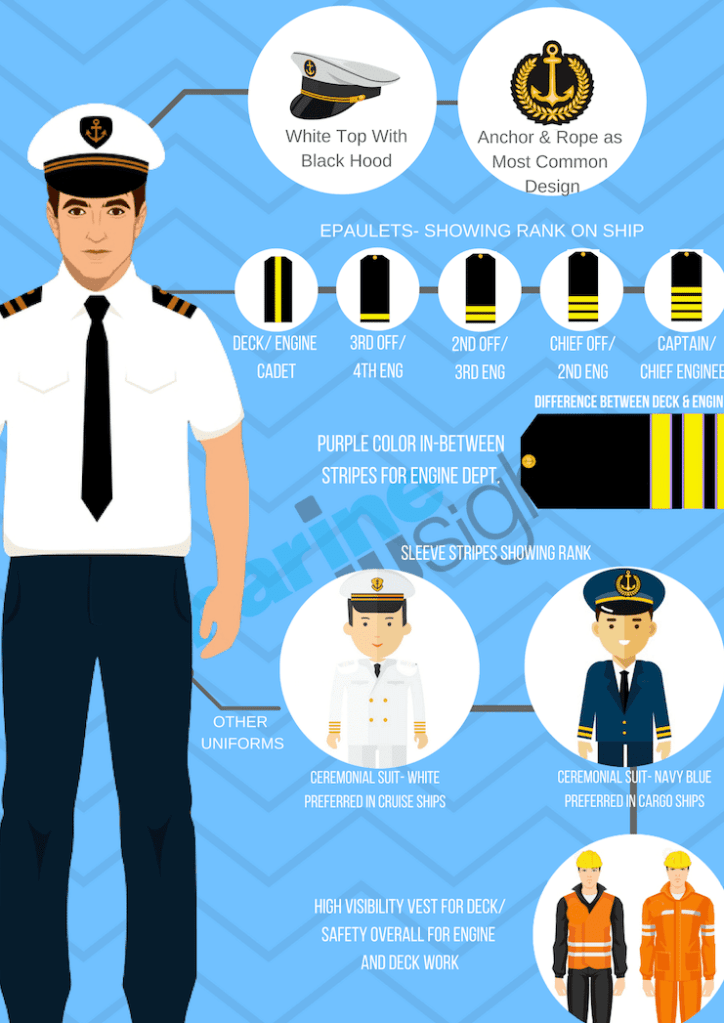
SALARY OF SHIPBOARD OFFICERS
| RANK | SALARY (AVERAGE) INR |
| CAPTAIN AND CHIEF ENGINEER OFFICER | 10 TO 12 LAKHS PER MONTH |
| FIRST MATE AND SECOND ENGINEER OFFICER | 6 TO 8 LAKHS PER MONTH |
| SECOND MATE AND THIRD ENGINEER OFFICER | 4 TO 6 LAKHS PER MONTH |
| THIRD MATE AND FOURTH ENGINEER OFFICER | 2 TO 4 LAKHS PER MONTH |
| DECK AND ENGINE CADET | 1 TO 2 LAKHS LAKHS PER MONTH |
| COOK | 2 TO 4 LAKHS LAKHS PER MONTH |
Salaries of Shipboard Officers mostly depends upon type of Ships and Currency they are paid in.
There is another rank pursued after Class 10th or 12th by candidates which is called GP RATING (GENERAL PURPOSE). GP Rating candidates work under officers for watchkeeping certificates (Rank – AB, BOSUN, OILER, FITTER, PUMPMAN). GP rating is considered as non uniform ranks
 MARINE MIRROR
Leave a comment