AUTHOR : TARUN KANSAL

WWW.MARINE-MIRROR.COM
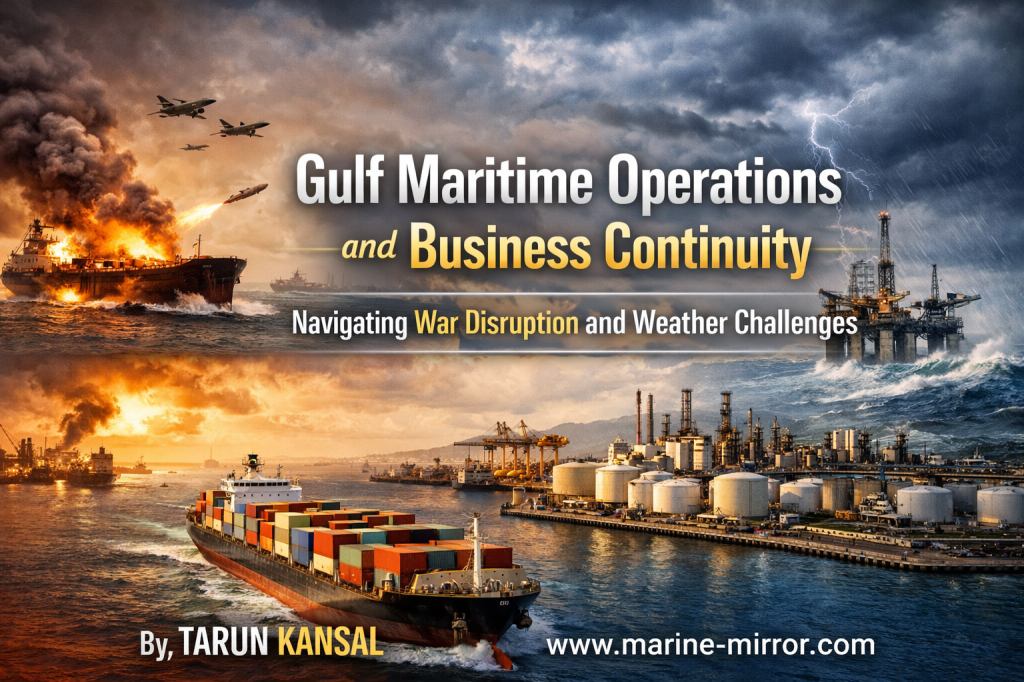
The maritime sector in the Gulf is facing one of its most complex operational periods in recent years. Conflict-driven disruptions, combined with increasingly unstable weather conditions, have reshaped trade flows, elevated risks, and opened new commercial opportunities across shipping, tug operations, and the offshore support industry. This article provides a comprehensive breakdown of the current environment and highlights where marine service providers can strategically position themselves for resilience and growth.
1. Current Situation in the Gulf: The Operational Reality
The Strait of Hormuz, one of the most strategically important waterways in the world, is currently under significant stress. This narrow passage handles nearly a fifth of the world’s crude oil and refined product flows; any disruption sends immediate shockwaves across global supply chains.
Key operational developments
- Flow through the Strait of Hormuz is significantly disrupted, affecting nearly 20 percent of the world’s oil movement.
- Oil exports have dropped sharply, with millions of barrels per day offline or delayed.
- Many ships are held up, rerouted, or waiting at anchor, creating heavy congestion across ports in the UAE, Oman, and adjacent coastal areas.
- Freight markets have tightened, pushing charter rates upward as vessel availability shrinks.
Operational impact felt across fleets
- Delays in berthing, inspections, and cargo operations
- Longer voyage times as ships divert to avoid high-risk zones
- Sharp rise in insurance premiums, especially war-risk coverage
- Increase in floating storage as cargo cannot move out efficiently
This combination of congestion, risk exposure, and reduced export capacity has reshaped fleet deployment strategies across the region.
2. Current and Upcoming Marine Weather Conditions: What to Expect
The Gulf is facing a spell of unstable weather, which—when layered onto geopolitical tension—creates a high-risk operational window.
Weather outlook for the coming days
- Winds: Northwesterly to northeasterly, 10–25 km/h, gusting up to 35–40 km/h
- Sea state:
- Arabian Gulf: slight to moderate, occasionally turning rough
- Conditions:
- Partly cloudy skies
- Likelihood of light rain
- Periodic dust and reduced visibility
- Offshore waves: 5–7 ft in multiple pockets
Operational consequences
When rough seas combine with war-risk conditions, the following risks increase:
- Machinery failure and blackouts
- Drifting vessels near traffic-dense zones
- Higher collision and grounding probability
- Slower port and terminal operations
- Increased reliance on tugs, pilots, emergency response, and standby support
Overall, even routine operations now require heightened vigilance and additional support assets.
3. How Tugs Can Earn in This Environment
Tug operators are among the first to see demand rise during periods of instability. Each operational challenge translates directly into service requirements.
3.1 Emergency towage and salvage
- Vessel breakdowns caused by attacks, technical failures, or rough seas create immediate towage demand
- Salvage operations during conflict or adverse weather can be extremely high-value engagements
3.2 Port congestion income
- With ships waiting longer at anchorages, tugs are needed frequently for:
- Berthing and unberthing
- Shifting between anchorages
- Assisting deep-draft vessels in limited weather windows
3.3 Escort operations
- Tankers, LNG vessels, and high-risk cargo ships require tug escorts in restricted or high-risk zones
- War-risk and rough sea conditions significantly increase escort requirements
3.4 Standby and firefighting roles
- Ports strengthen emergency preparedness during periods of conflict
- Tugs are deployed as:
- Firefighting units
- Emergency response vessels
- Safety standby support for terminals and offshore structures
4. How Offshore Companies Can Earn
Offshore support vessel operators are also witnessing a surge in opportunity due to the reconfiguration of the region’s energy logistics.
4.1 Increased offshore production support
- Oil prices rise during supply disruptions, encouraging higher production
- Countries shift to alternative routes, increasing demand for:
- Anchor-handling tug supply (AHTS) vessels
- Platform supply vessels (PSVs)
- Crew transfer boats
4.2 Floating storage operations
- When oil cannot move, it is stored offshore
- Offshore vessels are needed for positioning support, supply runs, and maintenance
4.3 Subsea inspection and repair
- Conflict increases the risk of damage to pipelines and subsea terminals
- This boosts demand for ROV support vessels, diving support vessels, and subsea repair teams
4.4 Alternative export routes support
- Gulf countries increasingly rely on pipelines and new terminal routes, especially via Fujairah and Oman
- Offshore logistics support near these hubs becomes essential
5. How Shipping Companies Are Making More Money
Despite the crisis, shipowners—especially tanker operators—are experiencing strong earnings due to a combination of scarcity, risk premiums, and route extensions.
5.1 Freight rate increase
- Reduced vessel supply leads to higher freight rates
- Charterers pay significant premiums to secure tonnage
5.2 War risk surcharge
- Shipowners add war risk premiums, security fees, and transit risk surcharges
- These additional charges substantially increase voyage earnings
5.3 Longer routes mean higher revenue
- Vessels avoiding conflict may sail via the Cape of Good Hope
- Longer voyages result in more hire days and additional bunker consumption billed (depending on contract terms)
5.4 Floating storage earnings
- Tankers used as storage units generate daily hire without burning fuel
5.5 Contract renegotiation advantage
- Shipowners renegotiate contracts at higher rates
- The spot market becomes more attractive than long-term fixed agreements
6. Combined Effect of War and Weather
Individually, war and weather create disruption. Together, they generate a highly complex operational environment.
This combination results in:
- Higher accident probability
- Slower port operations
- Escalated risk mitigation costs
- Stricter insurance and regulatory requirements
- Greater dependence on marine support services
Demand strengthens across:
- Tugs
- Offshore support vessels
- Emergency response units
- Marine logistics companies
7. Key Risks and Limitations
Despite commercial opportunities, the industry must remain alert to:
- Crew safety concerns, including refusal to sail
- Insurance restrictions or unavailability in high-risk zones
- Sudden port closures triggered by security alerts
- Financial instability and payment delays from affected regions
8. Strategic Insight for UAE Maritime Companies
For companies operating in the UAE and surrounding regions, this period presents both challenges and opportunities.
Strengths of UAE-based operators
- Proximity to crisis zones enables rapid mobilization
- Strong marine infrastructure and available fleet capacity
- Established emergency, firefighting, and offshore logistics capabilities
Operators positioned to benefit most
Companies with the following capabilities stand to gain:
- DP-class offshore vessels
- Firefighting-capable tugs
- Salvage and towage response teams
- ROV and subsea intervention capacity
Final Summary
The Gulf maritime sector is operating at the intersection of geopolitical tension and challenging weather. This combination is reshaping trade routes, increasing operational delays, and elevating the importance of marine support services.
Shipping companies, tug operators, and offshore vessel providers are seeing increased opportunities through:
- Disruption of normal trade flows
- Higher freight and charter rates
- War-risk surcharges
- Extended voyage durations
- Greater reliance on marine support assets
Current Gulf weather conditions—moderate to rough seas, dust, and strong winds—are further amplifying delays and increasing the need for tug assistance, offshore vessels, and emergency response. This period, though challenging, offers strategic advantages for well-equipped and responsive maritime companies within the UAE and the wider Gulf region
AUTHOR : TARUN KANSAL©

To read more articles and maritime insights by Tarun, visit: http://www.marine-mirror.com
 MARINE MIRROR
Leave a comment