AUTHOR : TARUN KANSAL

WWW.MARINE-MIRROR.COM
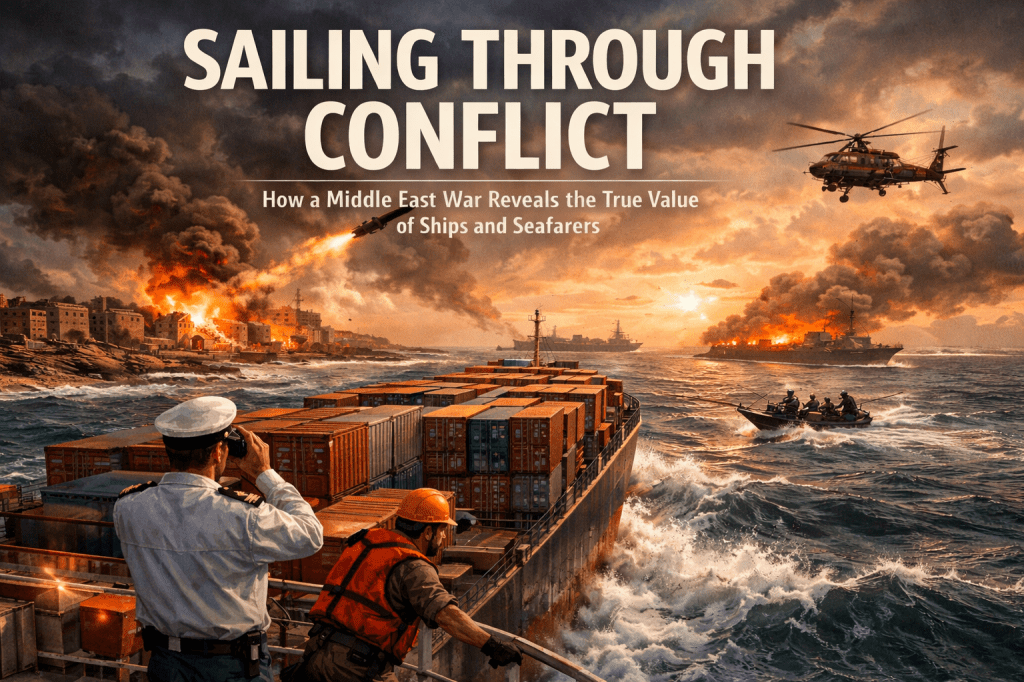
For decades, global trade has been treated as a efficient, predictable, and largely invisible to the average person. Goods appear on shelves, fuel flows uninterrupted, and economies function seamlessly. But it often takes a crisis to expose the truth: the global economy is not self-sustaining—it is carried, quite literally, on the backs of ships and the resilience of seafarers.
Nowhere is this more evident than during conflict in the Middle East.
Positioned along critical maritime arteries like the Strait of Hormuz and the Red Sea, the region is not just geopolitically sensitive—it is economically indispensable. When tensions escalate here, the impact is not regional. It is global, immediate, and deeply disruptive.
When Trade Routes Turn into Risk Zones
In times of peace, shipping lanes are simply lines on a chart. In times of war, they become high-risk corridors.
Oil tankers, LNG carriers, and container vessels suddenly operate under the shadow of missile threats, naval confrontations, and asymmetric warfare. A single disruption in these waters can send shockwaves across global markets.
Rerouting vessels around the Cape of Good Hope is not just a navigational adjustment—it is a logistical and economic burden, adding weeks to voyages and millions in additional costs.
“The world economy does not collapse overnight—it slows, ship by ship.”
This is when the illusion of seamless trade begins to break.
Seafarers: The Unseen Frontline
While headlines focus on military movements and political narratives, another group quietly steps into the frontline—seafarers.
Unarmed and often overlooked, they continue to sail through conflict zones to keep global trade moving. They face uncertainty not just from the sea, but from the realities of war—threats, stress, and isolation.
The COVID-19 pandemic offered a glimpse into their sacrifices, when thousands were stranded at sea, unable to return home. A geopolitical conflict intensifies that hardship, placing them in environments where the risks are no longer just operational—but existential.
“A seafarer does not just navigate oceans—they navigate uncertainty, every single day.”
The Fragility of Global Supply Chains
We often speak of globalization as if it were indestructible. But maritime conflict reveals just how fragile it truly is.
Over 80% of global trade is transported by sea. When key routes are threatened:
- Energy supplies tighten, pushing fuel prices upward
- Food and essential goods face delays
- Manufacturing slows due to disrupted raw material flows
Suddenly, supply chains are no longer abstract systems—they are tangible, vulnerable, and deeply human-dependent.
“Behind every stocked shelf is a ship that arrived—and a crew that made it happen.”
The True Cost of Risk
Conflict doesn’t just disrupt routes—it reshapes economics.
War-risk insurance premiums surge. Shipping companies face difficult decisions: proceed through danger or reroute at enormous cost. Either way, the financial impact cascades through the global economy, eventually reaching the end consumer.
What was once invisible—the cost of safe, reliable shipping—becomes impossible to ignore.
Shipping as Strategic Lifeline
A Middle East conflict also forces nations to confront a strategic reality: maritime trade is not just commerce—it is survival.
Energy security, food supply, and industrial continuity all depend on safe passage through these waters. Navies begin escorting merchant vessels, reinforcing a powerful truth—commercial shipping and national security are inseparable.
“Ships may fly commercial flags, but they carry the lifelines of nations.”
A Long-Overdue Recognition
The importance of ships and seafarers does not begin with conflict—but it is during conflict that their value becomes undeniable.
They are the silent enablers of modern life, operating beyond the public eye, ensuring that economies function and societies remain stable. Yet, recognition often comes only when disruption occurs.
A war in the Middle East does not create dependency on maritime trade—it exposes it.
Visibility Through Vulnerability
In a world accustomed to instant availability and uninterrupted supply, disruption is a powerful teacher.
It reminds us that global trade is not an abstract system powered by algorithms—it is a physical network, sustained by steel vessels and human endurance.
“No ships, no trade. No seafarers, no ships. No movement, no modern world.”
As geopolitical tensions reshape global dynamics, perhaps the greatest lesson is this:
The maritime industry is not just part of the global economy—it is its foundation.
And the people who keep it moving deserve not just acknowledgment in times of crisis, but respect—always.
The Middle East has long been a region where geopolitical tensions spill into the maritime domain, but the recent escalation has once again exposed a critical truth: global trade depends on ships, and ships depend on seafarers. While the world focuses on military developments and political narratives, a silent crisis unfolds at sea. Merchant vessels—carrying energy, food, and essential goods—are navigating through active conflict zones, while the men and women onboard face risks far beyond the scope of their profession. This conflict has forced the world to confront the reality that maritime trade is not just an economic function—it is a lifeline sustained under pressure.
A History of Maritime Conflict in the Region
The dangers faced today are not new. The Strait of Hormuz has historically been one of the most sensitive maritime corridors in the world. During the Iran-Iraq War, the “Tanker War” saw hundreds of commercial ships attacked in an attempt to disrupt oil exports. More recently, incidents involving vessels such as Front Altair, Kokuka Courageous, and the seizure of Stena Impero demonstrated that merchant shipping has long been a strategic pressure point. These historical patterns have now re-emerged with greater intensity, driven by modern weaponry and escalating regional tensions.
Recent Incidents: A Growing List of Ships Under Attack
In the past month alone, the scale of attacks has reached alarming levels, with over 20 confirmed incidents and numerous vessels directly struck across the Gulf and surrounding waters. What began as isolated strikes quickly evolved into a sustained threat against commercial shipping.
Among the vessels affected, the bulk carrier Mayuree Naree suffered a direct hit that caused severe fire damage, forcing emergency response from the crew. Tankers such as Sonangol Namibe, Mussafah 2, and Louise P were also attacked in rapid succession, demonstrating how energy carriers have become prime targets. Container ships including Safeen Prestige, MSC Grace, Express Rome, and One Majesty were struck by projectiles while transiting high-risk waters, while bulk carrier Star Gwyneth reported hull damage after an impact above the waterline.
Further incidents include attacks on tankers Safesea Vishnu and Zefyros, which resulted in casualties and highlighted the deadly nature of these assaults. Earlier in the escalation, the crude tanker Libra Trader was hit near Fujairah, signaling the widening geographic spread of attacks. At the same time, vessels such as LPG carriers Shivalik and Nanda Devi managed to transit under extreme caution, while others like the VLCC Advantage Victory and hundreds of ships remained stranded, unable to safely proceed.
What makes this situation particularly alarming is the indiscriminate nature of the attacks. Ships of different flags, ownerships, and cargo types have all been targeted, creating an environment where no vessel can be considered safe. The Strait of Hormuz, already a critical chokepoint, has now become one of the most dangerous shipping lanes in the world.
Seafarers: The Human Cost Behind Every Voyage
Behind every ship name is a crew facing unimaginable challenges. Seafarers onboard affected vessels have experienced missile strikes, onboard fires, emergency evacuations, and prolonged uncertainty while stranded at sea. On vessels like Mayuree Naree, crew members were forced to respond to life-threatening situations with limited resources, demonstrating exceptional courage and professionalism.
Thousands of seafarers remain caught in the region, many unable to disembark due to security risks and operational constraints. They face extended contracts, limited communication with families, and constant psychological stress. Every transit through high-risk waters carries the fear of attack, yet these individuals continue to perform their duties to ensure that global trade does not come to a halt.
Unlike military personnel, seafarers are civilians—yet they are exposed to the same dangers. Their role in sustaining economies, especially during crises, remains largely unrecognized, even as they risk their lives daily.
“Ships may carry the world’s cargo, but seafarers carry the world’s responsibility.”
The Strategic Importance of the Strait of Hormuz
The Strait of Hormuz remains central to this crisis. A significant portion of the world’s oil and gas supply flows through this narrow passage, making it indispensable to global energy security. Any disruption—whether through direct attacks, military escalation, or perceived threats—immediately impacts global markets.
Recent developments have led to reduced vessel traffic, increased insurance costs, and heightened operational risks. Ships are forced to delay, reroute, or proceed under extreme caution. The situation has demonstrated how a single chokepoint can influence the stability of the entire global economy.
Lessons Learned and the Way Forward
This conflict has exposed critical vulnerabilities in maritime security. There is an urgent need for stronger international coordination to ensure safe passage through high-risk areas. Protected maritime corridors, naval escorts, and real-time intelligence sharing must become standard practice during such crises.
Shipping companies must also invest in enhanced onboard security systems, crew training, and advanced monitoring technologies. At the same time, greater emphasis must be placed on seafarer welfare—including mental health support, fair compensation, and recognition as essential workers operating in high-risk environments.
The industry and global authorities must work together to ensure that ships are not left exposed and that seafarers are not left unprotected.
Conclusion: A Wake-Up Call for the World
The events unfolding in the Middle East have delivered a powerful and urgent message: without ships, global trade stops—and without seafarers, ships do not move. Every attacked vessel, every delayed transit, and every stranded crew member is a reminder of how much the world depends on an industry it rarely acknowledges.
This is more than a maritime crisis—it is a global realization. Ships are not just carriers of cargo; they are the arteries of the global economy. Seafarers are not just workers; they are the individuals who keep those arteries flowing under the most dangerous conditions imaginable.
If there is one lesson to take forward, it is this: protecting ships and seafarers must become a global priority, not an afterthought.
“In every conflict at sea, it is not just trade that is at risk—it is human life.”
Ships connect continents, but seafarers connect humanity
MARINE MIRROR – REFLECTIONS FROM THE OCEAN
 MARINE MIRROR
Leave a comment